
Anivance AI

Building Infrastructure for Human Validation
AI-Orchestrated Human Validation, from Experiment to Decision.
The Problem Isn’t Innovation It’s Fragmentation
Innovation is everywhere.
The challenge is connecting them.
Traditional Models Are Reaching Limits
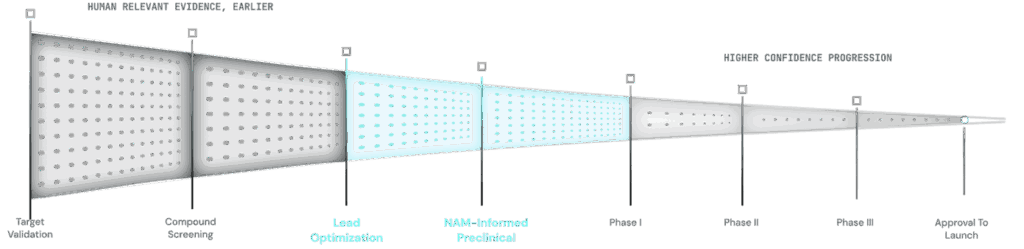
More than 90% of drugs that clear animal studies never win approval. Regulators are actively moving beyond them.
AI Is Generating Discoveries Faster Than Ever
Prediction is no longer the constraint.
Human-Relevant Tools Already Exist
Organoids, iPSC models, primary cells, organ-on-chip, multi-omics, automation — Each one powerful. Each one an island.
Every Program Rebuilds Same Stack
Different protocols, different platforms, different readouts. Results don’t transfer. Evidence doesn’t compound.
The Next Leap Is Integration

Connecting human biology, experimental control and AI workflows.
“we’re not using AI simply to analyze experiments. We’re building toward AI that can orchestrate experiments”
Guan Yu Chen, Ph.D.
Founder & CEO
Anivance Platform
Human tissue models, controlled experiments and connected intelligence.
Organ-On-Chip
S-Series
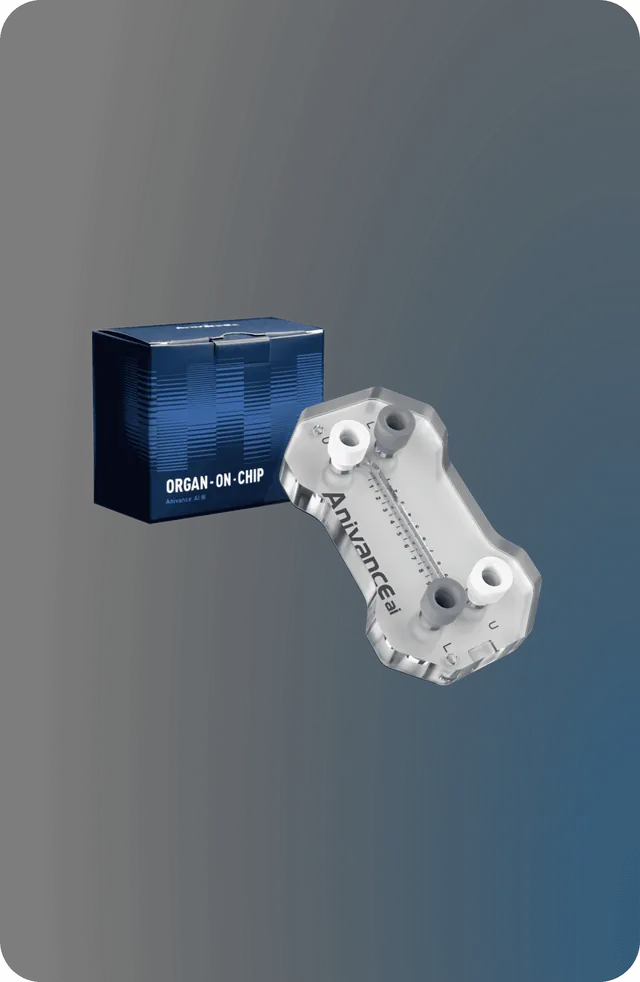
Build your tissue model on S-Series.
Match S-Series to your tissue model, culture interface and study readouts.
IN YOUR WORKFLOW
Connect the product to your experiment.
Model requirements
Define the tissue arrangement and culture conditions for your study.
Configuration consultation
Discuss chip specifications, connections and supported measurements.
APPLICATIONS
Respiratory model setup
Start with the tissue model, culture interface and exposure question. Match the S-Series setup to the readouts your lung study needs.
E-Series
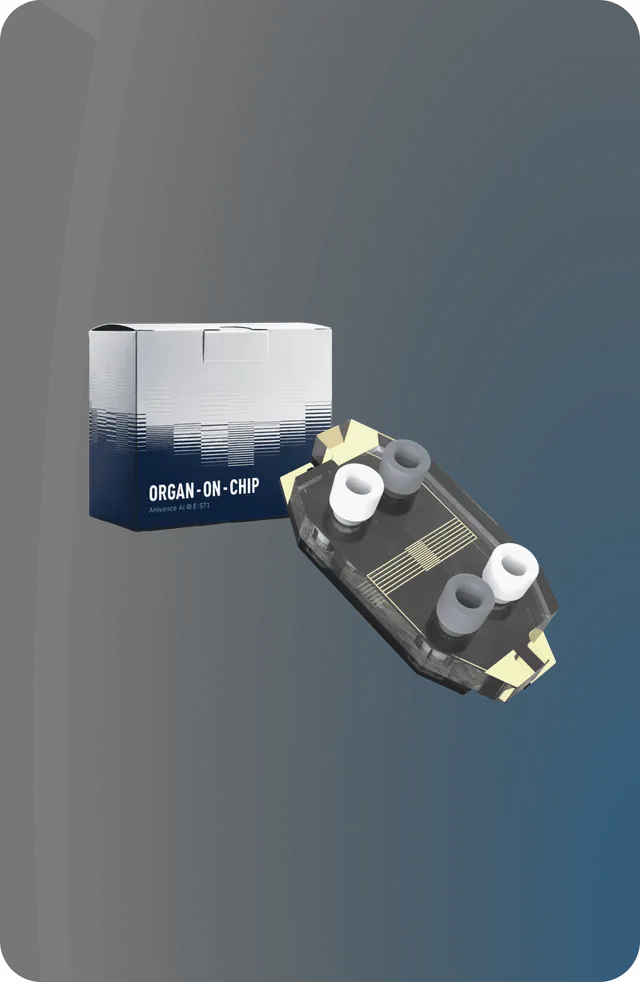
Electrode-integrated organ-on-chip.
E-Series integrates electrodes into the chip for electrical measurements of the biological model.
IN YOUR WORKFLOW
Connect the product to your experiment.
Integrated electrodes
An electrode-integrated chip architecture makes the measurement interface part of the model setup.
Measurement-led study design
Define the electrical readouts needed to study the model response, then confirm the measurement method and system compatibility.
APPLICATIONS
Barrier measurement
Use the integrated electrodes to connect your barrier model with electrical measurements. Confirm the readouts and compatible sensing system for your study.
H-Series
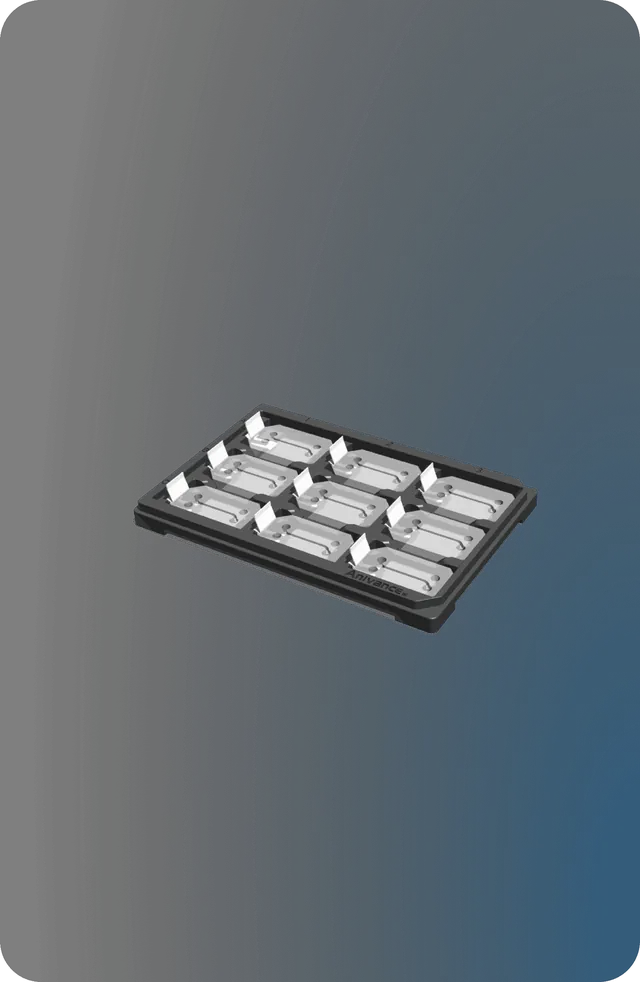
One multi-chip unit, corresponding to nine conventional chips.
H-Series brings a multi-chip approach to studies that need more experimental conditions or replicates.
One unit corresponds to nine conventional chips, offering a consolidated setup compared with working with individual chips.
IN YOUR WORKFLOW
Connect the product to your experiment.
Multi-chip architecture
One H-Series unit corresponds to nine conventional chips.
Plan conditions and replicates
Plan culture conditions, measurements and replicate groups in the multi-chip setup.
MPS
MPS-LITE
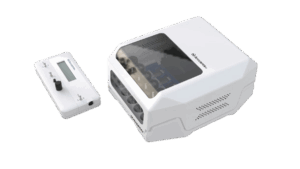
Ready-to-deploy dynamic perfusion culture.
Maintain long-term perfusion culture of 3D tissues with controlled flow and shear stress. Fits standard cell-culture incubators.
IN YOUR WORKFLOW
- ・Plug-and-play
Simplify initial setup and start your organ-on-chip workflow. - ・Dynamic perfusion
Maintain flow conditions for long-term tissue culture. - ・Real-time imaging
Observe cellular responses with compatible microscopy.
SPECIFICATION
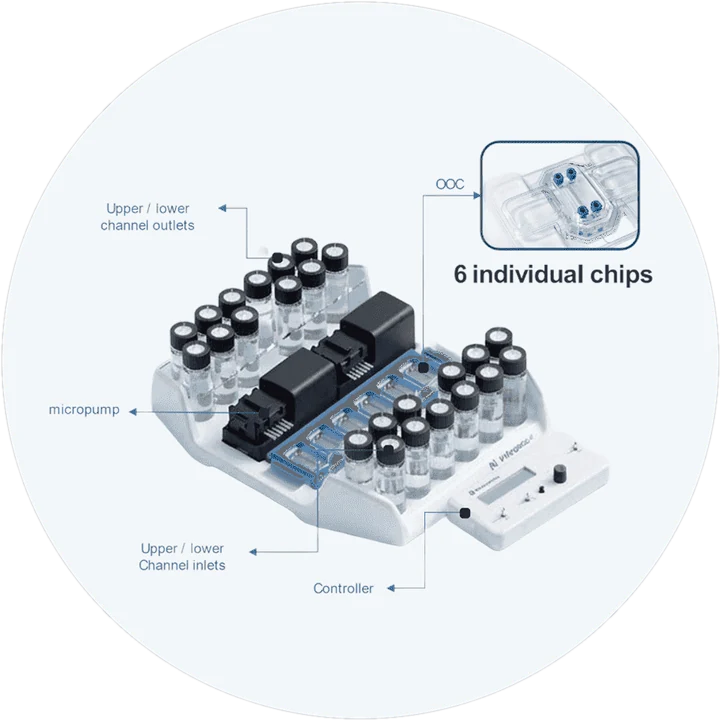
Dimensions
211 × 250 × 76 mm
Chip capacity
6 chips
Flow rate
1.0-100.0 µL/min
Flow rate accuracy
±20%
Power supply
AC 110-220 V%
MPS-CORE
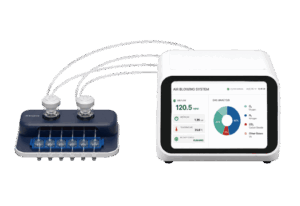
Precise aerosol delivery for inhaled-drug research.
Deliver aerosols to lung-on-chip tissues at an air-liquid interface to study deposition, absorption and clearance.
IN YOUR WORKFLOW
- ・Air-liquid interface
Expose cultured respiratory tissue under dynamic airflow. - ・Low nebulization volume
Plan aerosol exposure from a minimum volume of 200 µL. - ・Single-use components
Incorporate disposable components into the exposure workflow.
SPECIFICATION
Chip capacity
6 chips
Particle size
< 5 µm
Exposure volume
≥200 µL
Flow rate
20 mL/min
Exposure duration
5-10 min
Patent
US11732230B2
MPS-PRO
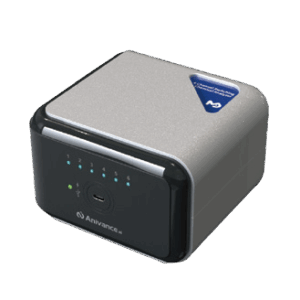
Real-time, label-free barrier assessment.
Track tissue barrier formation and changes with electrical impedance spectroscopy (EIS) for non-destructive, longitudinal measurements.
IN YOUR WORKFLOW
- ・Real-time sensing
Connect electrical barrier measurements with live-cell imaging. - ・Barrier monitoring
Follow formation, maturation and changes in tissue integrity. - ・Drug response
Compare longitudinal electrical responses across study conditions.
SPECIFICATION
Chip capacity
6 chips
Measurement principle
EIS
Frequency range
10 µHz-200 kHz
AC amplitude range
1-900 mV RMS
Monitoring interval
0.1 s
Data visualization
Bode, Nyquist & time-course plots
Data export
Excel & CSV
Physical AI
Physical AI connects intelligence with devices and physical experimentation as the platform develops.
Agentic AI coordinates the workflow through three roles: Plan, Coordinate and Interpret.
MPS-CORE Aerosol Deposition Simulation
Explore aerosol transport and deposition in a virtual MPS-CORE experiment.
Agentic AI Orchestrator
- ・PLAN
Proposal and Study Design agents translate AI hypotheses, drug candidates and study goals into an experimental plan. - ・COORDINATE
Execution and Imaging agents connect human models, experimental steps and review points. - ・INTERPRET
Analysis and Reporting agents bring measurements and context together as evidence for the next decision.
Lab-In-The-Loop
Explore three parts of the lab-in-the-loop collaboration.
The process, handoff and deliverables.
HUMAN VALIDATION
Bring a research question
Build a study around organ-on-chip models and MPS capabilities, and receive evidence with the context needed for your next decision.
PHYSICAL AI ENABLEMENT
Connect your discovery workflow
Define how your AI or discovery workflow can connect with orchestration, human validation and evidence handoff through a platform collaboration.
One Infrastructure Two Ways In
Human Validation
Evaluate drug response, permeability and organ safety.
Lung & Inhalation Assessment
Evaluate inhaled drug delivery and lung safety using human airway and alveolar models.
Drug Deposition Tissue Response Inhalation Toxicity
BBB & Drug Permeability Assessment
Assess how well drug candidates cross human blood–brain barrier models and whether they affect barrier integrity.
Drug Permeability Barrier Integrity Candidate Comparison
Organ-Specific Safety Assessment
Evaluate potential toxicity of drug candidates and ADC payloads across human heart, bone marrow, kidney, and liver models, with organ-specific assessments tailored to each tissue.
Organ-Specific Toxicity Dose Response ADC Payload Comparison
Physical AI Enablement
Connect AI hypotheses with experiments and evidence.
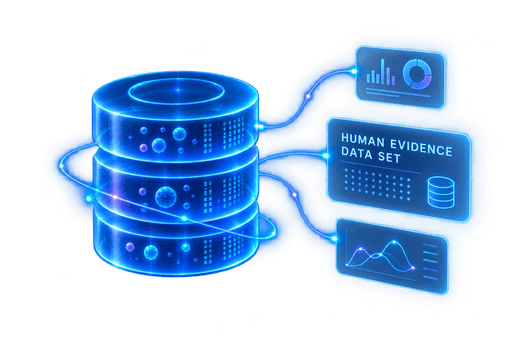
01. Hypothesis Generation

02. Confidence Assessment

03. Human Evidence Request
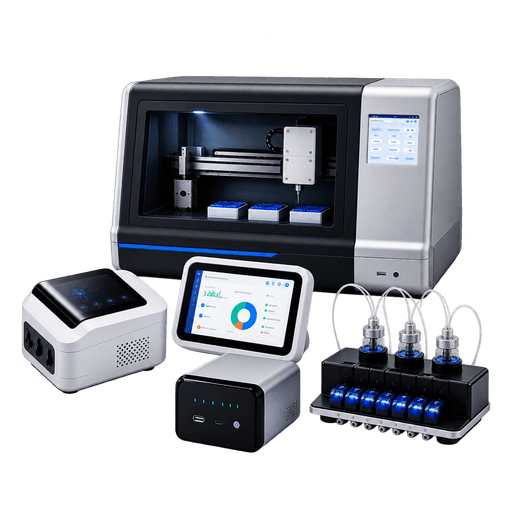
04. Human Validation (Anivance Platform)

05. Human Evidence Dataset
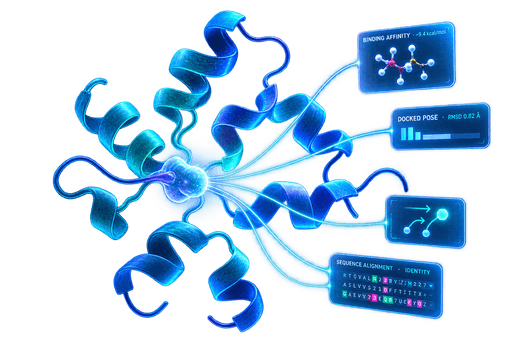
06. Model Retraining (BioNeMo)

07. Better Predictions, Better Decisions
Please contact us for any inquiries, questions, or information requests.
Tokyo Future Style, Inc.
info@tokyofuturestyle.com
TEL:029-851-9222 FAX:029-851-9220
